
Cervical Spinal Stenosis
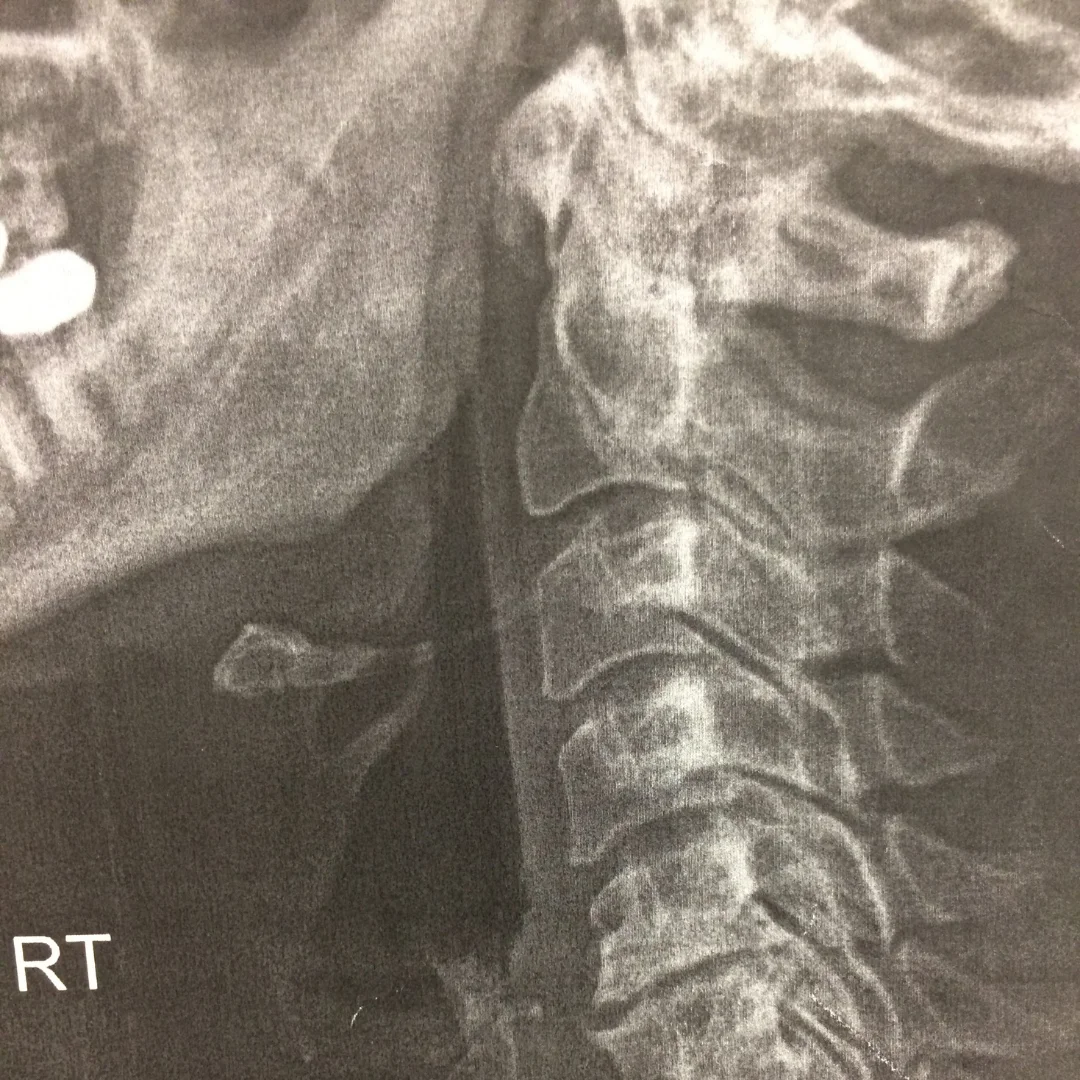
There are 7 vertebrae in the neck region, and they support the head. Between these vertebrae lie rubbery, cushion-like pads called discs, which allow movement and, by absorbing the load coming from the upper levels, ensure that it is transmitted smoothly to the lower levels. There are also joints and very strong ligaments that connect the vertebrae to one another. Over time, and especially after the age of 50, the discs lose their elasticity, the ligaments and joints thicken, and the bony structures become coarser. This entire process of degeneration (deterioration) causes the spinal canal in the neck to narrow, so that the spinal cord and nerves passing through it come under pressure and can no longer perform their normal function. Cervical spondylosis (calcification of the neck) is a condition we see after the age of 50, and it occurs more frequently after the age of 70.
The most common complaints are numbness in the arms, weakness, a sensation of electric tingling spreading through the body, and, most importantly, clumsiness of the hands. Problems can also arise in the legs. There may be complaints such as a loss of strength or a feeling of tightening in the legs while walking, as well as unsteadiness. A gait disturbance develops, and patients begin to walk in a spastic manner. The clinical picture is directly related to the severity and duration of the pressure on the spinal cord. A spinal cord that remains under pressure for a long time can, over time, suffer partial or complete damage. A gait disturbance caused by narrowing of the canal in the neck can be confused with other neurological diseases and with conditions such as osteoarthritis of the knee and hip. The diagnosis can be made through a detailed history taken by a specialist physician, a physical examination, and advanced investigations.
The most dramatic aspect of a narrowing of the spinal canal in the neck is that the condition is usually progressive. Although medication and physical therapy can be applied, they may temporarily provide some improvement but do not change the course of the disease. What needs to be done is to widen the canal surgically and relieve the nerves. This is because if the pressure on the spinal cord continues, the loss of function that develops in the cord is usually irreversible, since the spinal cord has no ability to repair itself.
The diagnosis is made first with a detailed neurological examination and then with an MRI of the neck. Nerve conduction studies known as EMG and SEP can also be helpful. All of the findings must be consistent with the patient's complaints. There are many neurological diseases that mimic the same clinical picture. In such cases, the help of a neurologist can be sought in order to distinguish these conditions from one another.
In narrowing of the spinal canal in the neck, the type of surgery is decided according to the patient's age, general condition, and what is pressing on the spinal cord. The operation is performed by approaching from the front of the neck or from the back of the neck. In place of the bone and ligaments that are removed, metal implants (plates) and bone grafts that will take over their function need to be placed. In suitable cases, the operation can also be performed without the need for plates; the spinal cord and nerves may simply be decompressed.